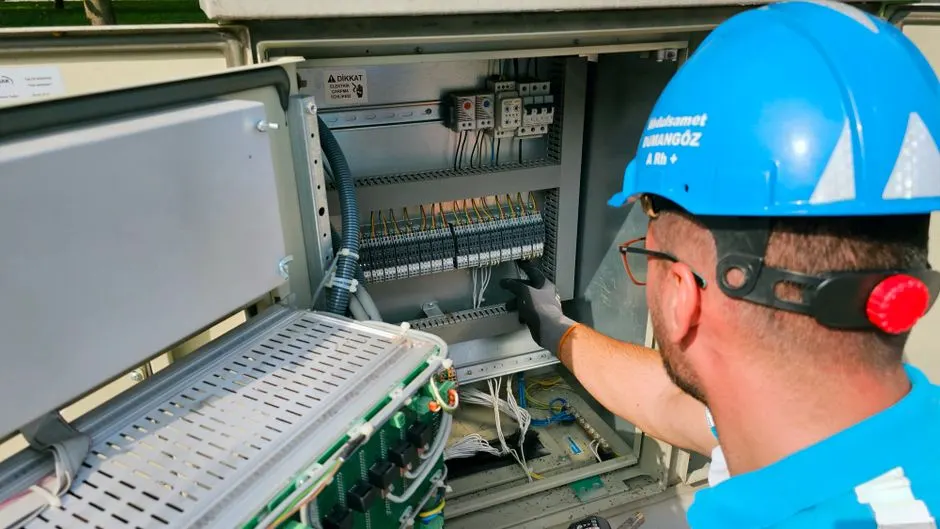
If your home has a 100-amp service panel, a fuse box, or a panel that is already full of breakers, you almost certainly need an electrical panel upgrade before a Level 2 EV charger can be installed. A 240-volt Level 2 charger pulls 32 to 48 amps continuously for hours, and most older Plant City homes simply do not have that spare capacity sitting on the bus bar.
Below we walk through the load math we run on every estimate, the physical warning signs inside your panel, what a 200-amp service actually costs here in 2026, and when a load management device lets you skip the upgrade entirely.
The short answer: run the load math first
How to tell if your home needs an electrical panel upgrade for an EV charger Plant City FL is really a load calculation question, not a guess based on the age of your house. An electrical panel upgrade for EV charger Plant City work is the process of replacing your existing service panel and meter base with a higher-amperage assembly that can carry the added continuous load of a 240V charger without tripping the main breaker.
The National Electrical Code (NEC 220.87 and 625.42) requires that the charger load be added to your home's existing calculated load, and the total cannot exceed your service rating. A Level 2 charger running at 40 amps adds 9,600 watts of continuous demand. If your existing load calculation already sits at 75 or 80 amps on a 100-amp service, you are over the limit the moment the charger kicks on.
We run that calculation on every job, and we do it with real numbers from your appliances, square footage, and HVAC tonnage - not a rule of thumb. Most Plant City homes built between 1955 and 1990 land in the 70 to 90 amp range before the charger is even added.
Signs you need an electrical panel upgrade for an EV charger in Plant City FL
Signs you need an electrical panel upgrade for EV charger Plant City homeowners should watch for show up both on paper and physically inside the panel itself. Here are the ones we see most often.
- 100-amp main breaker. The number is stamped on the main breaker handle. If it says 100, you are at the edge.
- No open breaker slots. A 240V charger needs a double-pole breaker, which means two adjacent empty spaces. Most older panels have zero.
- A fuse box instead of breakers. Any home still running screw-in fuses needs a full service change before an EV charger goes in.
- Warm panel cover or a burning smell. That is heat from loose terminations or an overloaded bus. Stop and call an electrician.
- Double-tapped breakers. Two wires under one lug is a code violation and a sign the panel is already maxed out.
- Aluminum branch wiring or a 60-amp service. Common in Plant City homes from the 1950s and 60s near the historic downtown district.
If you spot two or more of those, plan on an upgrade. If you only spot the 100-amp main and you have two open slots, we can sometimes make it work with load management - more on that below.
100 amp vs 200 amp panel for EV charger Plant City FL
A 200-amp panel is the standard we install for EV charger work in Plant City, and a 100-amp panel is usually too small once you add a 40-amp charger to an all-electric home. Here is how the two compare in practice.
100-amp service. Handles a gas furnace, gas water heater, and standard lighting and outlets. Add a 40-amp EV charger and you are at 80 to 95 amps of calculated load - right at the trip point. Add central AC and an electric range and you are over.
200-amp service. Handles an all-electric home with central AC, electric range, electric water heater, dryer, and a 48-amp EV charger with room to spare. This is the service we recommend for any home that plans to keep an EV for the next decade.
400-amp service. Needed for homes with two EVs charging at once, a pool heat pump, a workshop, or a detached garage subpanel. We install these in the rural stretches east of Plant City where lots are larger and outbuildings are common.
The upgrade itself is a one-day job in most cases. We pull the meter, swap the panel and meter base, install the new grounding electrode system, and get the inspection scheduled. Power is off for four to six hours.
What size electrical panel do I need for an EV charger in Plant City Florida?
For a single Level 2 EV charger in a typical Plant City home, a 200-amp panel is the right size - it gives you the 40 to 60 amps of dedicated capacity the charger needs plus headroom for everything else in the house. A 100-amp panel only works if your home is mostly gas and you install a load management device.
Here is the math we use. A 48-amp charger on a 60-amp breaker draws 11,520 watts. A 40-amp charger on a 50-amp breaker draws 9,600 watts. A 32-amp charger on a 40-amp breaker draws 7,680 watts. NEC 625.42 requires the charger to be treated as a continuous load at 125% of its rating, so a 40-amp charger counts as 50 amps against your service.
If your existing calculated load is 80 amps on a 100-amp service, adding 50 amps puts you at 130 - well over. On a 200-amp service, 80 plus 50 is 130, which leaves 70 amps of headroom. That is why the 200-amp panel is the answer for most homes.
We size every job this way, and we document the calculation for the permit. If you want to see how we handle the full scope, our Home EV Charger Installation Plant City FL page walks through the residential process from load calc to final inspection.
Electrical panel upgrade for EV charger cost in Plant City, Florida
Typical 2026 pricing in this area runs $1,800 to $3,500 for a 200-amp panel upgrade, and $3,500 to $6,000 if you also need a new meter base, a longer service drop, or a 400-amp service. The charger install itself is a separate line item, usually $800 to $1,800 depending on wire run length and whether you need a subpanel in the garage.
What drives the number up:
- Meter base replacement. Adds $400 to $900 if the existing base is rusted or undersized.
- Service mast and weatherhead. Adds $300 to $700 if the mast is damaged or too short.
- Grounding electrode system. Adds $200 to $500 if you need new ground rods and bonding.
- Long wire runs. A 60-foot run from the panel to the garage costs more than a 15-foot run.
- Permit and inspection fees. Plant City and Hillsborough County fees typically run $150 to $350.
We quote the panel and the charger together so you see one number. No surprise line items after we open the wall.
When a load management device beats a full panel upgrade
A load management device lets you install a 40-amp EV charger on a 100-amp service by automatically pausing the charger when the house approaches its limit. It is the right call when your home is mostly gas, your panel is in good shape, and you do not want to spend $2,500 on a service change.
The device clamps around the main service conductors, monitors total draw, and cuts power to the charger when the house crosses a set threshold. When the AC cycles off or the oven finishes, the charger resumes. You still get a full charge overnight - the pauses are short.
We install these regularly, and our EV Charger Load Management Installation Plant City FL page covers the hardware options and how the monitoring works. It is not the right answer for every home, but for a 100-amp service with gas appliances it saves real money.
If your panel is a fuse box, has visible heat damage, or is a 60-amp service, load management is not an option. You need the upgrade.
What to watch out for
The biggest mistake we see is homeowners buying a 48-amp charger before anyone checks the panel. A 48-amp charger on a 100-amp service will trip the main breaker the first hot afternoon when the AC and the charger run together.
Other things to watch:
- Cheap 14-50 outlets. A $15 big-box receptacle is not rated for the continuous duty of EV charging. We install industrial-grade Hubbell or Bryant receptacles, or hardwire the charger.
- Undersized wire. A 48-amp charger needs 6 AWG copper at minimum for a short run. Longer runs need 4 AWG. We see 8 AWG used on 50-amp circuits far too often.
- No permit. Unpermitted EV work can void your homeowners insurance and cause problems at resale. We pull the permit and schedule the inspection.
- Federal Pacific or Zinsco panels. These brands have known failure issues. If you have one, the upgrade is not optional.
- Aluminum wiring at the charger terminations. Aluminum expands and contracts with heat. Copper pigtails are required.
If you are also considering a Tesla unit, our Tesla Wall Connector Installation Plant City FL page covers the specific wiring and commissioning steps for that hardware.
When to call a professional
Call a licensed electrician the moment you see a warm panel cover, a burning smell, scorch marks on a breaker, or a main breaker that trips when the AC starts. Those are not DIY problems.
For EV charger work, call us before you buy the charger. We run the load calculation, tell you whether a panel upgrade is needed, and quote the whole job - panel, charger, permit, and inspection - as one number. VoltFix Installation handles the full scope, and we have done this across Plant City, from the older homes near downtown to the newer builds out toward SR-60.
If you are in a neighborhood like Walden Lake or Country Hills, we can usually tell you from a photo of your panel and a quick phone call whether you are looking at a simple install or a full service change.
Frequently Asked Questions
How do I know if my home needs an electrical panel upgrade for an EV charger in Plant City FL?
Check your main breaker rating. If it says 100 amps or less, or you have a fuse box, you need an upgrade. If you have a 200-amp panel with two open slots, you probably do not. We confirm with a load calculation before quoting.
How much does an electrical panel upgrade for an EV charger cost in Plant City?
Typical 2026 pricing runs $1,800 to $3,500 for a 200-amp upgrade, plus $800 to $1,800 for the charger install itself. Meter base replacement, long wire runs, and 400-amp service push the total higher.
What size electrical panel do I need for an EV charger in Plant City Florida?
A 200-amp panel is the standard for a single Level 2 charger in a typical home. A 100-amp panel only works with a load management device and mostly gas appliances. Two EVs or a pool usually mean 400 amps.
Who can upgrade my electrical panel for an EV charger in Plant City FL?
A licensed electrical contractor with a Hillsborough County or Plant City permit. The work involves the meter, service drop, and grounding system, so it is not a handyman job. We pull the permit and handle the inspection.
Can I install a Level 2 charger without upgrading my panel?
Yes, if you have a 200-amp panel with spare capacity or you install a load management device on a 100-amp service. A 32-amp charger on a 40-amp breaker is the smallest practical option and fits more panels than a 48-amp unit.
Get help with EV Charger Installation in Plant City
We run the load calculation, tell you straight whether you need a panel upgrade, and quote the whole job as one number. If you want a real answer instead of a guess, call VoltFix Installation at 1112222333 and we will walk you through it.